
ONCOLOGY AND RADIOPHARMACEUTICALS
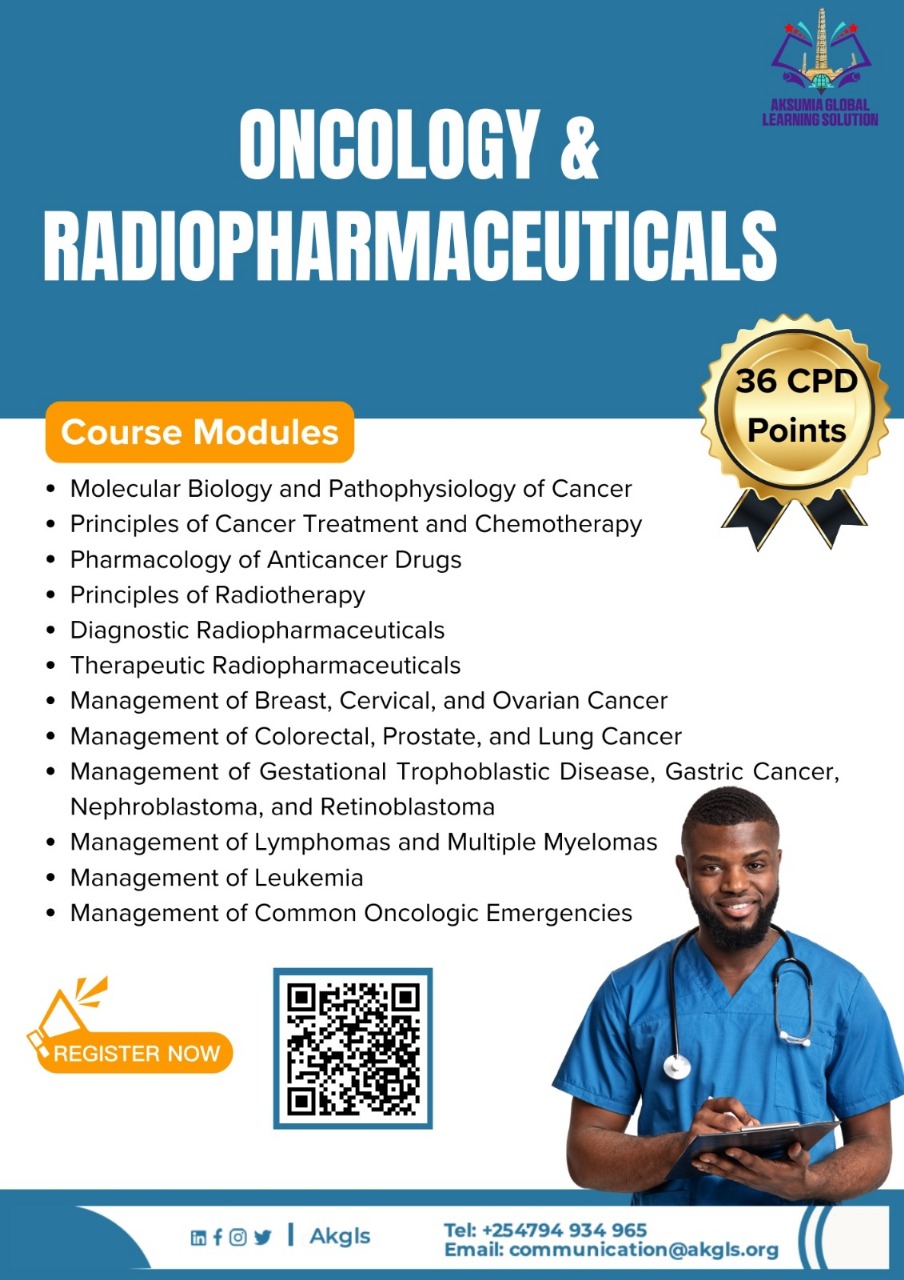
The Oncology and Radiopharmacy Short Course Training is a comprehensive program designed to equip healthcare professionals with advanced knowledge and practical skills in cancer treatment and radiopharmacy. This training enhances understanding of molecular and cellular mechanisms of cancer, various treatment modalities, and the use of radiopharmaceuticals in both diagnostic and therapeutic contexts.
ICT Requirements
By the end of the training, participants will be able to:
Throughout the training program, various assessment techniques will be employed:
Pre-Test: Evaluates baseline knowledge before training begins
Progress Assessment: Daily online tests to reinforce learning
Post-Test: Comprehensive final evaluation covering all modules
Case Studies: Real-world scenario applications
Self-Paced Learning: LMS-based tests for knowledge reinforcement
To qualify for a certificate of participation, candidates must achieve a minimum passing score of 80% on the post-test.
This course is designed for healthcare professionals and individuals interested in oncology and radiopharmacy.
To obtain CPD or CME Credit, complete the post-tests with an 80% pass rate, submit the evaluation survey online, and a certificate will be emailed within a week of completion.
To provide a comprehensive understanding of the molecular mechanisms and biological processes that underlie cancer development, progression, and metastasis. This module will cover the key genetic and cellular changes that contribute to the transformation of normal cells into cancerous cells.
• Explain the molecular basis of cancer
• Describe the role of genetic mutations and oncogenes in cancer development
• Discuss the mechanisms of metastasis and tumor progression
• Molecular basis of cancer
• Genetic mutations and oncogenes
• Tumor suppressor genes
• Mechanisms of metastasis
To introduce the fundamental principles of cancer treatment, including various therapeutic approaches and the classification of cancers. This module will also address the staging of cancer and the management of chemotherapy-related adverse drug reactions (ADRs).
• Define and classify various types of cancer
• Explain the TNM system of cancer staging
• Identify common terminologies in cancer treatment
• Describe various treatment approaches
• Manage chemotherapy-related ADRs
• Definitions, classification, and etiologies of cancer
• TNM system of cancer staging
• Common terminologies in cancer treatment
• Various treatment approaches of cancer
• Management of chemotherapy-related ADRs
To provide an in-depth understanding of the pharmacological properties, mechanisms of action, and clinical applications of anticancer drugs. This module will cover the pharmacokinetics, pharmacodynamics, and toxicity profiles of these drugs.
• Explain the mechanisms of action of anticancer drugs
• Describe the pharmacokinetics and pharmacodynamics of anticancer drugs
• Identify drug interactions and toxicity profiles
• Mechanisms of action
• Pharmacokinetics and pharmacodynamics
• Drug interactions and toxicity
This module will introduce participants with the principles and techniques of radiotherapy used in cancer treatment. This module will cover the fundamental concepts, various radiotherapy techniques, and their clinical applications.
• Explain the principles behind radiotherapy
• Describe different radiotherapy techniques and their applications
• Identify the indications and contraindications for radiotherapy
• Basic principles of radiotherapy
• Radiotherapy techniques
• Indications and contraindications
This module will provide knowledge on the use of radiopharmaceuticals in the diagnosis of cancer. This module will cover various diagnostic radiopharmaceuticals, their mechanisms of action, and their clinical applications.
• Identify various diagnostic radiopharmaceuticals
• Explain their mechanisms of action
• Discuss their diagnostic applications
• Types of diagnostic radiopharmaceuticals
• Mechanisms of action
• Diagnostic applications
This module will enable participants to explore the therapeutic applications of radiopharmaceuticals in cancer treatment. This module will cover the types, mechanisms of action, and safety considerations of therapeutic radiopharmaceuticals.
• Explain the therapeutic applications of radiopharmaceuticals
• Describe the mechanisms of action of therapeutic radiopharmaceuticals
• Identify safety and toxicity considerations
• Types of therapeutic radiopharmaceuticals
• Mechanisms of action
• Therapeutic applications
• Safety and toxicity
This module will provide participants with detailed knowledge on the epidemiology, risk factors, histological classification, clinical features, diagnosis, and treatment modalities of breast, cervical, and ovarian cancers.
• Explain the epidemiology and risk factors of breast, cervical, and ovarian cancers
• Describe the histological classification, clinical features, and diagnostic methods
• Discuss the treatment modalities for these cancers
• Introduction
• Epidemiology and risk factors
• Histological classification
• Clinical features and diagnosis
• Treatment modalities
This module will cover the management of colorectal, prostate, and lung cancers, including their epidemiology, risk factors, histological classification, clinical features, diagnostic methods, and treatment modalities.
• Explain the epidemiology and risk factors of colorectal, prostate, and lung cancers
• Describe the histological classification, clinical features, and diagnostic methods
• Discuss the treatment modalities for these cancers
• Introduction
• Epidemiology and risk factors
• Histological classification
• Clinical features and diagnosis
• Treatment modalities
This module will provide an overview of the management of gestational trophoblastic disease, gastric cancer, nephroblastoma, and retinoblastoma, focusing on their epidemiology, risk factors, histological classification, clinical features, diagnostic methods, and treatment modalities.
• Explain the epidemiology and risk factors of these cancers
• Describe the histological classification, clinical features, and diagnostic methods
• Discuss the treatment modalities for these cancers
• Introduction
• Epidemiology and risk factors
• Histological classification
• Clinical features and diagnosis
• Treatment modalities
This module will cover the management strategies for lymphomas and multiple myelomas, including definitions, epidemiology, risk factors, histological classification, clinical features, diagnostic methods, and treatment modalities.
• Define and classify lymphomas and multiple myelomas
• Explain the epidemiology and risk factors of lymphomas and multiple myelomas
• Describe the clinical features and diagnostic methods
• Discuss the treatment modalities for these cancers
• Definitions
• Epidemiology and risk factors
• Histological classification
• Clinical features and diagnosis
• Treatment modalities
This module will provide an in-depth understanding of leukemia management, including definitions, classifications, epidemiology, risk factors, clinical features, diagnostic methods, and treatment modalities.
• Define and classify different types of leukemia
• Explain the epidemiology and risk factors of leukemia
• Describe the clinical features and diagnostic methods
• Discuss the treatment modalities for leukemia
• Definitions and classifications of leukemia
• Epidemiology and risk factors
• Clinical features and diagnosis
• Treatment modalities
This module will equip participants with knowledge and skills to effectively manage common oncologic emergencies. This module will cover the definitions, classifications, and management of specific emergencies such as febrile neutropenia, superior vena cava syndrome, and more.
• Define and classify oncologic emergencies
• Recognize and manage specific oncologic emergencies such as febrile neutropenia, superior vena cava syndrome, and others
• Identify appropriate interventions for oncologic emergencies
• Definition and classification of oncologic emergencies
• Febrile neutropenia
• Superior vena cava syndrome
• Spinal cord compression
• Hemorrhagic cystitis
• Tumor lysis syndrome
• Hypercalcemia of malignancy
• Chemotherapy extravasation
Start straight away and join a global classroom of learners. If the course hasn't started yet, you'll see the future date listed below.
Join Today Available now